
Anne Arundel County Jail Roster Overview
Anne Arundel County inmate records are kept by the Department of Detention Facilities. That distinction is important. The Sheriff's Office serves warrants, process, peace and protective orders, and court security papers, but county jail custody is operated by the detention department. The detention department confines arrestees, pretrial detainees, and sentenced offenders, monitors alternatives to incarceration, and supports reentry programming.
The county's Inmate Locator is the public starting point. Its official scope is limited to people committed and currently housed at Anne Arundel County Detention Facilities. The locator may show housing location, future court dates, and bail information. It is not a state prison lookup, historical arrest-record search, or mugshot database. If a person has been sentenced to state custody, transferred, released, or held by another jurisdiction, the county locator may not return the record.
The Department of Detention Facilities overview source identifies the county agency behind Anne Arundel County inmate records.
That agency role explains why inmate lookup, visitation, commissary, and custody information are grouped under detention rather than the court clerk.
How to Use the Anne Arundel County Inmate Roster
The public locator is a current-custody lookup. Use it first when the person was recently arrested in Anne Arundel County or is believed to be held at a county detention facility. If the person does not appear, check court records for case and bail context, then use state and notification fallbacks. Formal charges and full court outcomes live in case records, so a custody lookup may need to be paired with Anne Arundel County arrest records and court charges.
- Open the Anne Arundel County Inmate Locator from the detention department site.
- Follow the on-screen lookup instructions and search by the inmate name details the form requests.
- Review any match for housing location, future court dates, and bail information.
- Use the facility contact number if the locator does not load, returns no match, or needs confirmation.
- Check Maryland DPSCS for sentenced state inmates and VINELink for custody notification needs.
The inmate locator source is the official county portal for current Anne Arundel County inmate records.
The locator's current-custody scope is the key limit to keep in mind when a search returns no result.
Anne Arundel County Inmate Search Fields
The public page states that users should follow the instructions to look up current inmates, but the live lookup widget loads dynamically. The research inventory confirmed the result scope even though live rows were not available without an active inmate query. The table below reflects the official page language and the fields documented from the lookup scope.
| Field Label | Type | Required | Notes |
|---|---|---|---|
| Inmate name search | Text | Likely required | Official page says to follow instructions to look up current inmates; live form loads client-side. |
| Results / housing location | Result field | n/a | Shows housing location when a current inmate is matched. |
| Future court dates | Result field | n/a | Included in the official result scope. |
| Bail information | Result field | n/a | Included in the official result scope. |
| Loading | Dynamic control | n/a | Lookup widget loads through the page. |
What Anne Arundel County Inmate Records Show
A public inmate profile should be read as a custody snapshot. It can identify whether the person is currently housed in Anne Arundel County detention and may connect the custody record to future court dates and bail information. It should not be expanded into details that the official public page does not confirm.
| Field | What It Shows |
|---|---|
| Name | Visible in lookup results when a current inmate is found. |
| Housing location | Official result scope for a matched current inmate. |
| Future court dates | Upcoming court-date information when available in the locator result. |
| Bail information | Bail information included in the official result scope. |
| Facility | Inferred from housing location, such as Jennifer Road or Ordnance Road. |
| Booking details, mugshot, charges, physical description | Not confirmed from the public page without a live result, so they should not be assumed. |
| State transfer status | Check Maryland DPSCS if the person is no longer in county custody. |
The detention facility roles source explains the system that houses the people returned by the county locator.
Facility role matters because intake, pretrial custody, sentenced custody, and reentry programming can point to different buildings.
Anne Arundel County Jail Facilities
Anne Arundel County detention operations use separate facilities for intake, pretrial detention, and sentenced or medium-security custody. The current-inmate locator may point to a housing location, but direct facility contact is still useful for visitation, accommodations, attorney access, and changes that occur after a lookup.
Jennifer Road Detention Center
131 Jennifer Road
Annapolis, MD 21401
410-222-7374
Maximum-security intake and pretrial facility; 635 rated capacity.
Central Holding and Processing Center
133 Jennifer Road
Annapolis, MD 21401
410-222-1200
Initial processing, search, interview, fingerprinting, and commissioner-hearing hold.
Ordnance Road Correctional Center
600 East Ordnance Road area
Glen Burnie, MD
410-222-4900
Medium-security facility for sentenced and pretrial custody; 540 rated capacity.
The Jennifer Road source identifies the intake and pretrial role behind many Anne Arundel County inmate records.
Jennifer Road is the maximum-security facility associated with many recent arrests and pretrial holds.
The Ordnance Road source describes the county's medium-security correctional center.
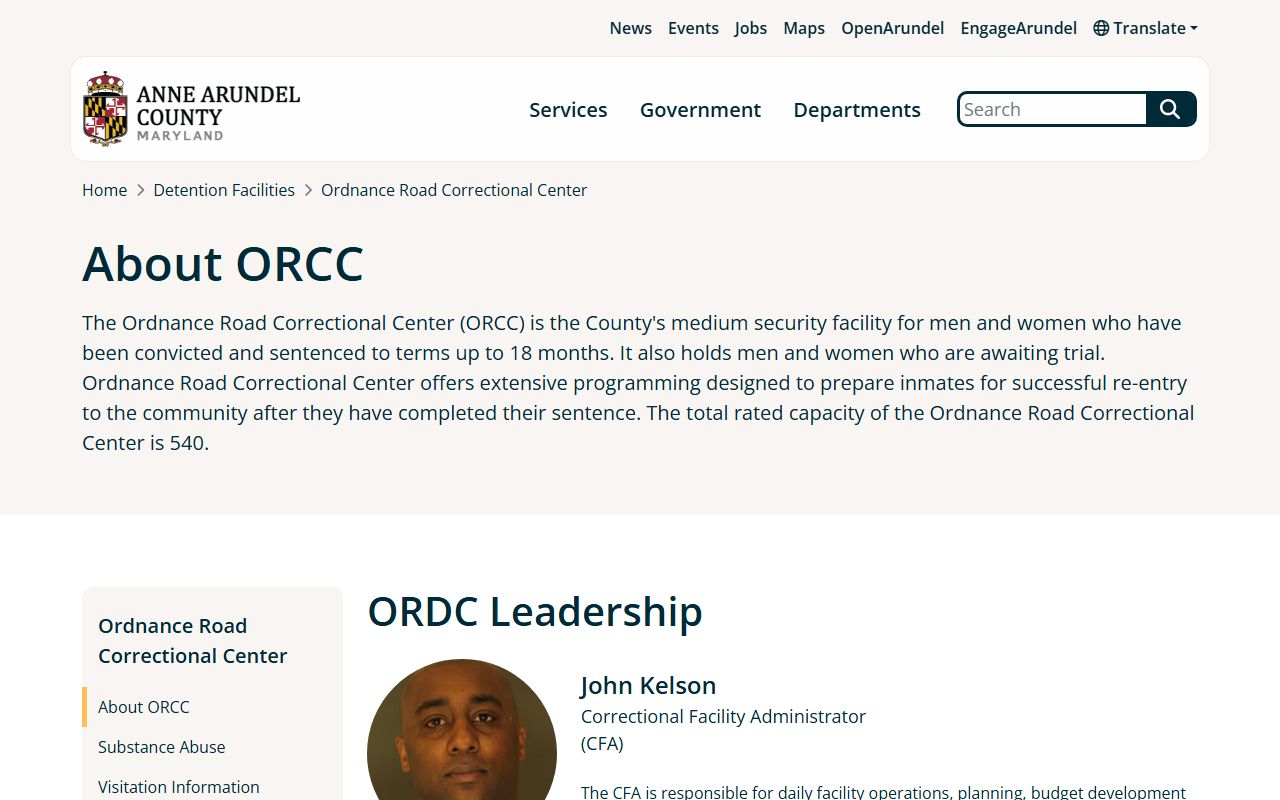
Ordnance Road can house sentenced offenders and people awaiting trial, so facility assignment is not the same as final case status.
Booking Process in Anne Arundel County
Central Holding and Processing Center accepts detainees from law-enforcement agencies operating in Anne Arundel County. On arrival, the individual is searched, interviewed, fingerprinted, and held until a commissioner hearing is scheduled. If the person remains held, the process continues through Jennifer Road for further processing, medical contractor review, and classification counseling.
That booking path explains why the inmate locator may show bail and future court dates but not a full charge history. A commissioner or court event may set bail or hearing dates before the formal case record is easy to find by name. If the public inmate record is not enough, use the case number, court date, or charge from the locator to search court records.
Legal-service access follows a different route than family visitation. The detention research identifies an inmate legal-services page for the private attorney and Public Defender application pathway. Maryland Office of the Public Defender representation depends on eligibility and the type of case, while private counsel may use professional visit rules. Family members who are trying to help should separate custody questions from legal-defense questions, because detention staff can confirm facility rules but cannot act as defense counsel or change the court case.
Note: County custody status can change faster than public search tools, especially after release, transfer, bond posting, or court action.
Visitation Hours and Rules
Visitation rules differ by facility and housing unit. All visitors must show a valid unexpired driver's license, government-issued ID, or passport. Passport users must also provide mail showing a current address. Visitors must check in at least 30 minutes before the end of each session. Jennifer Road uses non-contact visits, while Ordnance Road generally uses video visitation, with contact visits only for some programs.
| Facility | Schedule | Type |
|---|---|---|
| Jennifer Road | 8:00-10:30 a.m.; 12:30-3:00 p.m.; 6:00-10:00 p.m. depending on housing unit and day | Non-contact visits |
| Jennifer Road | Two personal visits per week, up to one hour, sometimes shortened during heavy visitation | Personal visits |
| Ordnance Road | Sunday-Thursday: 0800-1130, 1230-1500, 1830-2130 | Video visitation |
| Ordnance Road | Friday-Saturday: 0830-1100, 1230-1500 | Video visitation |
| Attorney visits | Jennifer Road attorney visits are allowed 24 hours a day, 7 days a week without prior authorization | Professional visit |
| Professional and clergy visits | Generally daily from 8:30 a.m. to 10:00 p.m. with required approval or credentials | Professional visit |
Out-of-area visitors may request a special visit through the on-duty receptionist, sergeant, or lieutenant when they live outside the Baltimore-Washington area. The county defines that special visit rule by a distance outside a 75-mile radius and allows it once during incarceration.
Visitor lists, check-in times, housing-unit schedules, and program conflicts can affect a visit even when the inmate appears in the locator. The county FAQ also notes differences between contact and non-contact visits, visitor-list rules, and special visits. Call the facility before traveling when the inmate has just been booked, moved, placed in a program, or scheduled for court.
How to Contact an Inmate
Contact options depend on facility rules, custody status, and professional role. Attorneys may visit Jennifer Road clients at any time without prior authorization. Approved clergy and other professional visitors must bring photo ID and professional credentials such as a bar association card, agency ID, ordination certification, badge, or law firm authorization for paralegals.
The Anne Arundel County Sheriff app is also relevant to inmate records. The Apple App Store listing advertises an inmate search and the ability to sign up for inmate change-of-status notifications. The Google Play listing advertises crime reporting, tips, Most Wanted, and sex offender search. The app does not replace the detention department locator, but it adds a useful notification channel when status changes matter.
Accessibility requests also use facility-specific contacts. For Jennifer Road accommodations, the research identifies the facility Security Captain at 410-222-4993 or dcvanc11@aacounty.org at least seven days before the event. For Ordnance Road, the contact is 410-222-4994 or dcdavi33@aacounty.org at least seven days before. TTY users may call Maryland Relay 711.
Commissary and Inmate Funds
Commissary deposits can be made at accesscorrections.com, by phone at 866-345-1884, or through a lobby kiosk. The county states that visitors may not hand deposits directly to staff. Visitors should confirm the inmate's housing location first, because release or transfer can affect whether funds should be sent.
The Maryland DPSCS inmate locator is the fallback for sentenced state inmates, while VINELink is the statewide custody-notification fallback identified in the research. The Maryland sex offender registry is separate from county jail custody and should not be treated as a current inmate roster. County detention records not shown in the locator may require the detention Public Information Request channel.
Scam warnings belong with inmate searches. Research notes that callers may claim they can arrange early release, bail, or ankle monitors for a fee. Verify any request for payment through the detention facility, court, bondsman, or counsel before sending money.
When a person disappears from the county inmate locator, the next step depends on the likely event. Release after bond may leave court dates in Case Search. Transfer to state custody points to DPSCS. A victim or family notification need points to VINELink. A sex-offender registration question points to the separate state registry. A request for logs, policies, or detention administrative records may need a county public information request instead of another inmate search.
Current custody records also should not be confused with court outcomes. Bail, future court dates, and housing location are useful for immediate status, but they do not prove guilt, conviction, sentence, or final disposition. Formal charge and disposition information comes from the court record, and some court details may be restricted, sealed, expunged, or unavailable online.